Designing trust into AI suggestions
Two working concepts exploring how to present model-generated suggestions so experts can act on them without being misled.
- Client
- Self-initiated concepts, 2026
- Team
- Solo. Designed and built by me with Claude Code and GitHub
- Result
- Two working prototypes. Not yet tested with users, and every organisation, person and figure is invented
Context
More and more operational software hands experts a suggestion or a flag that came from a model rather than a rule. I built two working concepts to explore how to present this kind of output so that experts can act on it without being misled.
Problem
The risk runs both ways. People either treat the suggestion as fact or learn to ignore it.
Key Design Moves
Two concepts
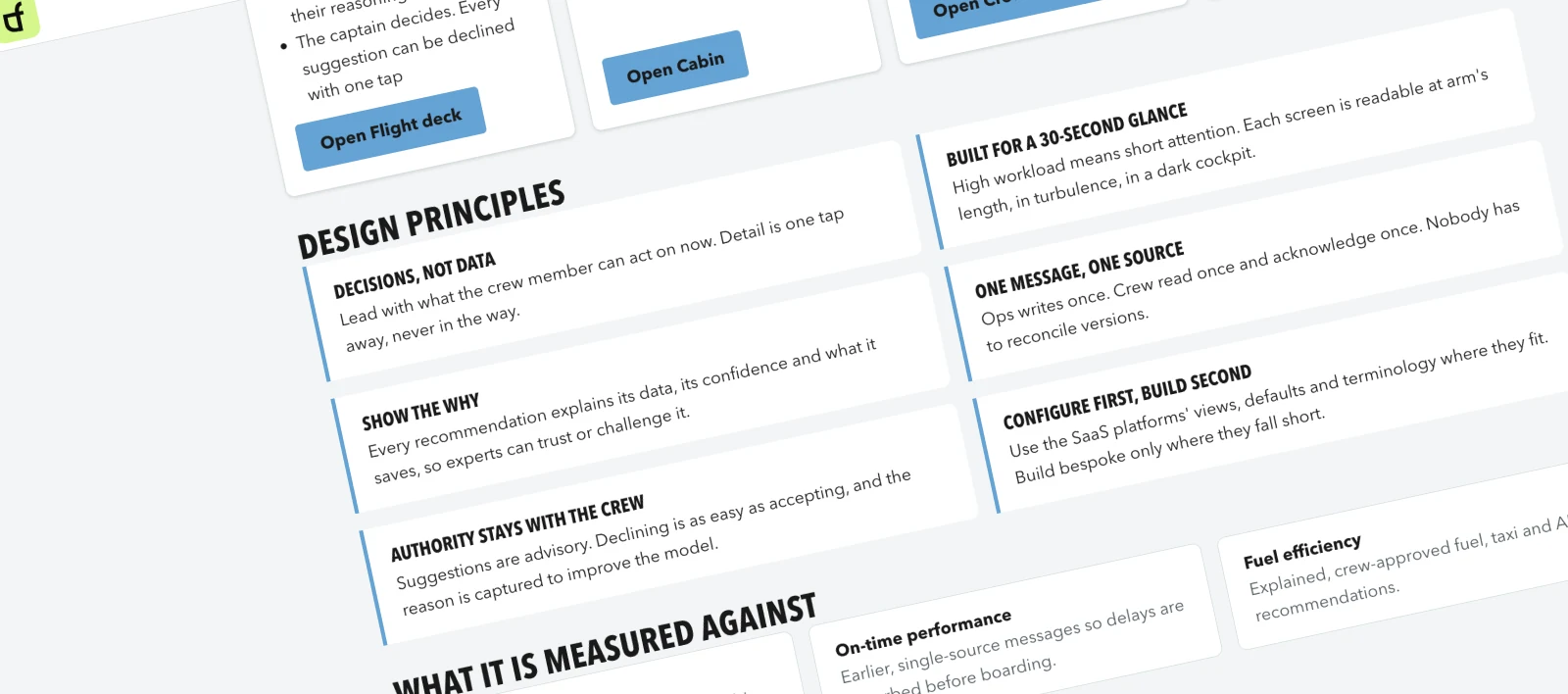
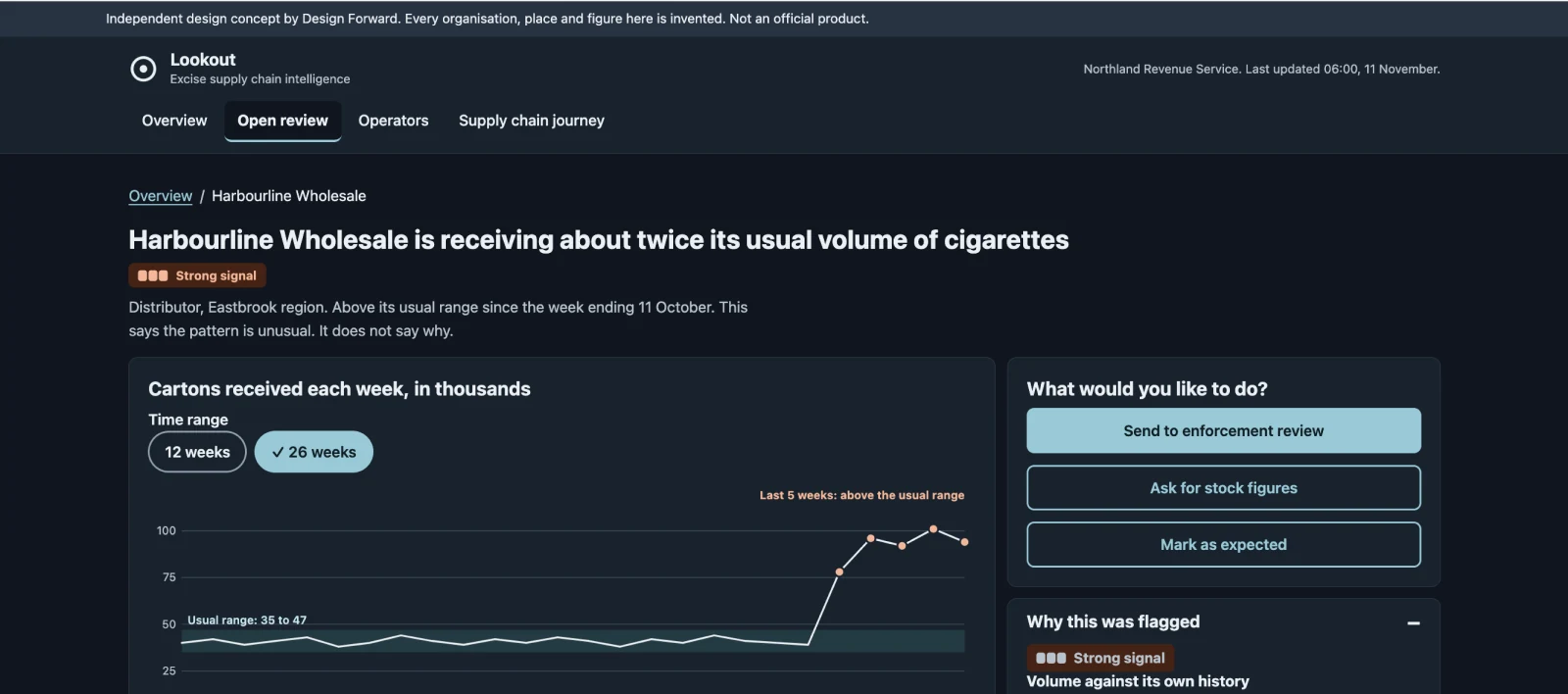
Lookout is a supply chain intelligence tool for an invented revenue service. It tracks taxable goods like cigarettes and spirits across billions of scan events and flags patterns that look unusual. Connected Crew is a set of tools for FlyUX, an invented airline. It gives pilots fuel and taxi suggestions, gives cabin crew a shared turn clock, and gives crew control one reliable message per change instead of thirty calls.
The decisions that mattered
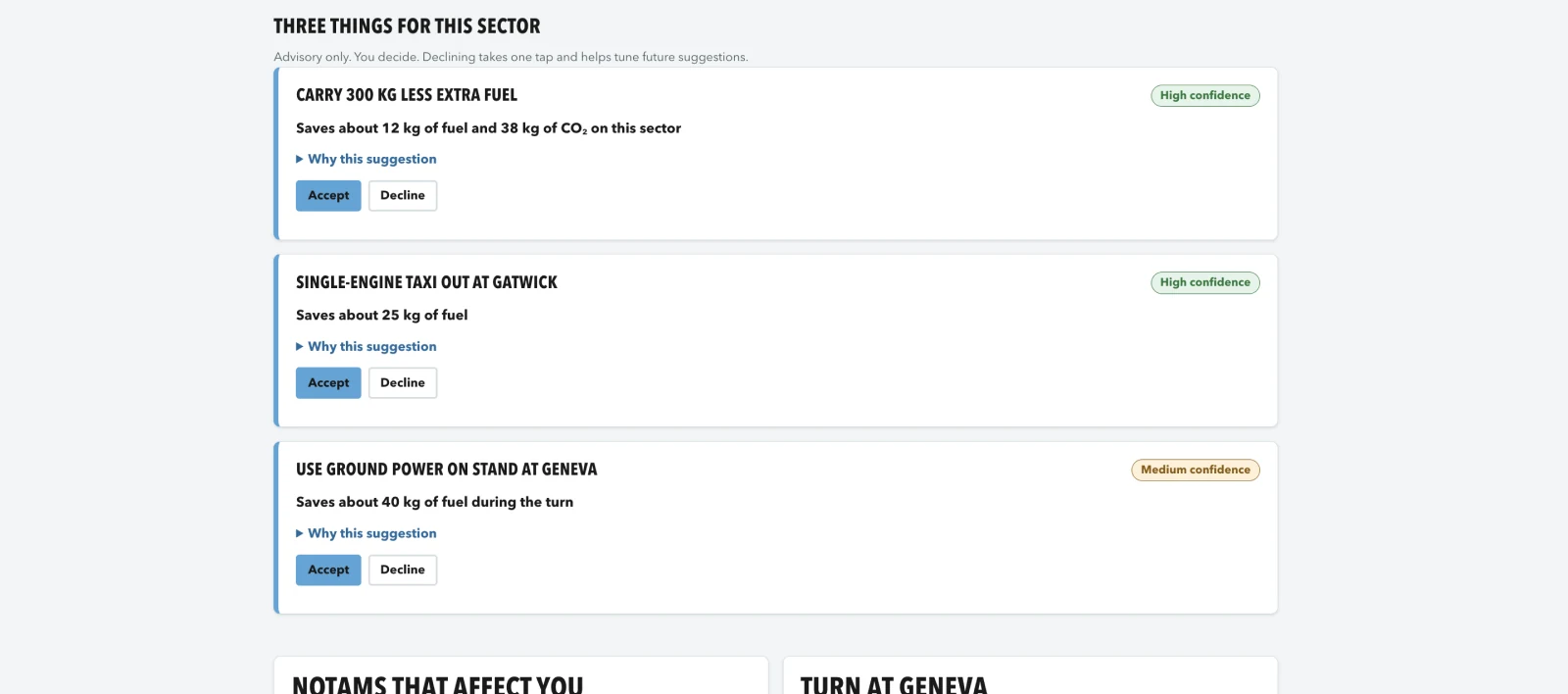
Every signal in Lookout is written out in words as well as shown with marks and colour, as early, moderate or strong. Each signal says how unusual a pattern is, never why it happened or whether anyone has done anything wrong. A review page sets out what the data shows next to what it cannot show, and lists possible explanations in no particular order, each with a different next step. Operators are compared with their own history, not a national average, because that's where real anomalies hide. In the field app, a scan has three results, not two. "We cannot tell" is an honest answer and it's better than a false "genuine". On the flight deck, pilots get three suggestions for the sector instead of a long list. Each one shows a confidence level, what it saves and why it was suggested. Declining is as easy as accepting, and the reason for declining feeds back into the model, so the system learns from the captain rather than the other way round.
How I built it
I built both concepts in Claude Code, working from a GitHub repo that publishes to a staging site. I set the rules once in a project file: plain UK English, invented data only, no outside scripts, and colour contrast and quality checks that run on every pull request. That meant I could move quickly without checking the basics by hand each time. Each concept went from blank page to clickable prototype in a few days. The prompts and constraints held up well. What went wrong was my own assumption. I assumed the airline would build all four crew tools itself, and the AI built exactly that, polished enough to look settled. Talking to the operations team at one airline, I learned that most of their crew-facing tools were bought from specialist vendors and configured rather than designed. For them, the real design work sat in the data dashboards and the joins between systems. I've left the prototype as it was, because the mistake is the useful part. It got me to that conversation, and to the right answer, much faster. My lesson: a fast prototype is the quickest way to get your assumptions corrected, as long as you remember that the finish on it is not evidence.
What I'd test first
Whether experts act on three explained suggestions but ignore a long list. Whether "we cannot tell" builds trust in the field or just frustrates people. And whether the strength of a signal is read the way it's meant to be: as a reason to look, not a verdict.